Glomus Tumours: Causes, Symptoms and Treatments

Glomus tumours are (sometimes cancerous) growths that start in nerves associated with the jugular vein, one of the main veins that takes blood away from the brain. They can arise anywhere in the side of the face or throat but are slow growing and do not often spread to other sites in the body. Glomus tumours that develop in the nerves associated with the ear can cause damage to the inner ear, leading to hearing impairment, deafness and dizziness.
Possible Sites of Glomus Tumours
The head of a human being is a congested place, crammed with major nerves, large blood vessels, bones, and muscles, all supporting and protecting the brain, three of the main sense organs, and the entrance to the airways and digestive system.Glomus tumours can develop in the nerves that monitor what is happening to the blood in the jugular vein. Specialised receptors called chemoreceptors keep a close watch on levels of oxygen, carbon dioxide and other blood components as the blood passes out of the brain through the jugular vein.
The large glomus bodies are the main chemoreceptors that monitor the blood in the jugular vein at the jugular foramen, the point where the jugular vein exits the skull at the temple. Smaller glomus bodies occur along the nerves in the face and those that are close to the middle ear. Normally, these groups of specialised nerves cells grow and expand through childhood and into adulthood and then stop at around the age of 40.
In some people, however, the glomus bodies carry on growing and some of the cells start to divide out of control, forming a cancerous tumour. Glomus tumours, also called paragangliomas can develop alongside the jugular vein, near to the carotid artery as it enters the head from the neck, in the inner ear, at the back of the nose, or in the trachea (the windpipe) or larynx (the voice box).
Causes of Glomus Tumours
Glomus tumours are classified as low grade brain tumours or low grade head and neck tumours. In a very few people, a genetic condition such as Li-Fraumeni syndrome may increase the risk of all types of tumour, and may be a factor. In others, exposure to radiotherapy or a carcinogenic chemical can be an explanation. Usually, in the vast majority of people who develop a glomus tumour, a definite cause cannot be identified.Symptoms of Glomus Tumours
Most people are completely unaware that they have a glomus tumour until they experience pulsatile tinnitus. This is one of the main symptoms of a glomus tumour. It is caused by the cancerous mass pressing on the bones of the inner ear. The pulsing sound is caused by the blood moving around the tumour as the heart beats. As the glomus tumour also fills the ear canal, it is also common to experience loss of hearing, complete deafness and vertigo (severe dizziness).If the glomus tumour has grown and is affecting other parts of the head or neck, some people can start to become hoarse, finding it difficult to speak properly and to swallow. If the tumour grows on nerves in the face, this can lead to numbness or paralysis. Spells of dizziness and headaches are also common, but on their own are not defining symptoms of glomus tumours as they can also be caused by many other underlying illnesses.
How Common are Glomus Tumours?
Fortunately glomus tumours are very rare, affecting only one person in every 1.3 million. Glomus tumours are three times more common in men than women, for reasons we do not understand, and usually occur between the ages of 40–70 years.Glomus Tumours: Diagnosis and Treatment
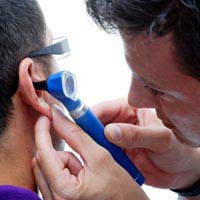
Glomus tumours of the middle ear can usually be seen by an examination of the ear with an auroscope. Imaging studies such as CT scans and MRI scans are then used to assess the extent of the tumour inside the head. Angiography, where contrast is injected into the tumour’s blood supply, is also routinely used to assess glomus tumours.Once a diagnosis has been made, the main treatment is surgery to remove the glomus tumour. An embolisation technique is often used day before surgery to make it more likely that the whole tumour will be removed in the operation. During embolisation tiny particles are injected into the tumour to block its blood supply. Embolisation allows complete removal of the tumour to be achieved in 90% of patients. If the tumour has grown large, or has started to spread to nearby tissues, radiotherapy is then used as a follow up after surgery.
Treatment of glomus tumours is generally very successful. Some people can be left with some symptoms such as hearing loss depending on the extent of their tumour, but 77% remain symptom-free 20 years after treatment.
- Ear Injections for Meniere's Disease
- How Does a Cochlear Implant Work?
- Types of Ear Surgery
- Drugs to Prevent Noise-induced Hearing Loss
- Can Music Help Tinnitus?
- What is an Ototoxic Drug?
- What is Auricular (ear) Acupuncture
- What to Expect from Ear Surgery
- Tinnitus Maskers
- Otoplasty or Pinning Back of the Ears
- Myringotomy
- Myringoplasty
- Ear Candling for Reducing Ear Wax Build Up
- Ear Drops and Their Uses
- Grommets and Your Ear
- Use of Antibiotics for Ear Infections

Re: Types of Ear Surgery
My child is born with deaf. So what should i do. Which treatment should i take to my child
Re: How Your Genes Shape Your Ear Lobes
My 2 month old has one free earlobe and his other ear has a half attached earlobe why? Should I be concerned?
Re: I Feel Dizzy and My Ear Itches: What Does it Mean?
I have noticed my ears are producing more sticky staff, itching and in the middle of last year I…
Re: Can Ear Wax Be Removed by Vacuum?
Vacuuming caused a 30% hearing loss. Don't allow it. Find a dr or audiologist who avoids it.
Re: Cysts and Tumours in the Ear
I had a pollock in my ear. can they regrow ?
Re: Grommets and Your Ear
@Ella - I'm afraid we can't give direct medical advice. The best option you have is to visit your GP and hope he/she will be able to help…
Re: Grommets and Your Ear
I had grommets when I was 2 and 5, a few weeks ago I found out I have scarring and 1 of my grommets are still in my ear meaning I had it in…
Re: Can Ear Wax Be Removed by Vacuum?
I had an ear wax removal procedure done at the Loma Linda, Ca Va facility. When the tech was vacuuming out the wax in my…
Re: Cysts and Tumours in the Ear
@CarrolA - I have no knowledge of your condition or what it might be. But if you want a quicker appointment, and peace of mind,…
Re: Cysts and Tumours in the Ear
I woke up one morning about five weeks ago with a feeling that my ear was blocked. A strange additional symptom is that every word…